
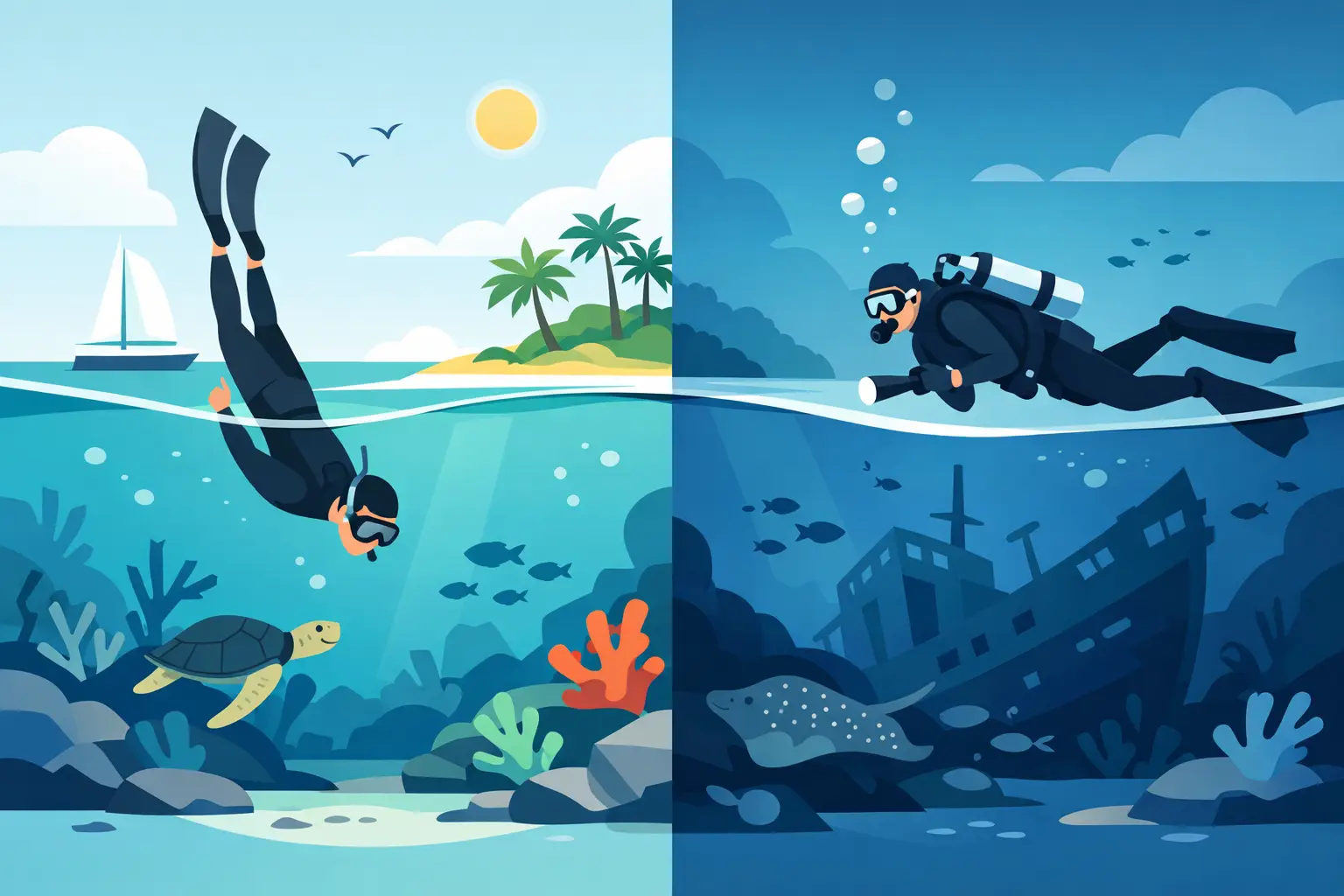

The moment you slip below Barbados’ sunlit surface, the island feels different: quieter, bluer, and wonderfully close. Choosing between freediving vs scuba lessons shapes how you experience that world. One invites you to move through the sea on a single calm breath; the other gives you time to linger over reefs, shipwrecks, and curious tropical fish.
Neither is automatically the better choice. The right lesson comes down to the feeling you want from your vacation, your comfort in the water, and whether you would rather travel light and fluid or stay below longer with air on your back.
Freediving vs Scuba Lessons: The Essential Difference
Freediving is breath-hold diving. You enter the water with fins, a mask, snorkel, exposure protection if needed, and a weight belt, then descend and return to the surface on one breath. A beginner freediving lesson focuses less on chasing depth and more on the skills that make each descent calm and controlled: relaxed breathing, efficient finning, equalizing your ears, body position, and safe buddy practices.
Scuba lets you breathe underwater through a regulator connected to a tank. In a scuba lesson, you learn how your equipment works, how to clear water from your mask and regulator, communicate with hand signals, manage buoyancy, and ascend safely. You can spend far more time observing the underwater scenery without needing to return to the surface after every short descent.
The difference is not simply breath versus tank. Freediving can feel minimal, meditative, and remarkably personal. Scuba feels immersive in another way – like being welcomed into an underwater landscape where you have time to look around.
Choose Freediving If You Want a Quiet, Natural Connection
Freediving often appeals to travelers who love the sensation of moving freely through the water. With less gear and no stream of bubbles, your experience can feel beautifully uncluttered. You may notice the sunlight dancing across the sand, the rhythm of your fins, and the sound of your own breath at the surface before you descend again.
For confident swimmers, a first freediving session can be an exciting introduction to a skill that rewards patience rather than force. The goal is not to prove how deep you can go. A quality instructor will help you slow down, use less energy, and recognize that comfort is far more valuable than competition.
Freediving may be a natural fit if you enjoy snorkeling but want a more intentional way to explore beneath the surface. It can also suit guests who prefer a light, streamlined setup and do not love the idea of wearing a tank, regulator, and buoyancy device.
There is a trade-off. Your underwater time is brief, particularly as a beginner. You will spend more time at the surface recovering between descents, and lessons require close attention to technique. Freediving is never a sport to practice alone or treat as a casual breath-holding challenge. Safe training means learning with an experienced professional and staying within your personal limits.
Choose Scuba If You Want More Time Below the Surface
If the thought of hovering beside a reef, watching a sea turtle cruise past, or exploring the details of a shipwreck sounds like your ideal Caribbean memory, scuba may be the stronger choice. The tank changes the pace of the experience. Instead of racing your breath, you can settle into the moment.
This makes scuba especially appealing for travelers who want to see as much marine life as possible on a single outing. Barbados offers clear water, vibrant reef systems, and fascinating wreck sites, and scuba gives you the time to appreciate the small details: a spotted moray easing out of a crevice, a school of silvery fish shifting as one, or coral formations shaped by years of ocean currents.
A beginner-friendly introductory scuba experience is designed for people without previous certification. You will start with a clear equipment briefing and practice essential skills in shallow water before heading out with your instructor. The experience is guided and paced around your comfort, not around anyone else’s confidence level.
Scuba does ask more of you in terms of equipment and procedures. Some guests need a few minutes to become comfortable breathing through a regulator or equalizing their ears. The gear can feel unfamiliar at first, especially if you are used to the simplicity of snorkeling. Yet for many first-timers, that initial adjustment quickly gives way to an unforgettable sense of weightlessness.
What Each Lesson Feels Like as a Beginner
A freediving lesson usually begins above the water. You will discuss breath awareness, relaxation, ear equalization, and the most important rule of the sport: always freedive with a properly trained buddy. In the water, your instructor may introduce surface breathing, duck dives, streamlined body position, and gentle descents along a line. The atmosphere is focused but unhurried.
The most surprising part for many guests is that freediving is not about taking huge, forceful breaths. Over-breathing can be unsafe. Good instruction prioritizes calm, normal preparation and a steady, measured approach. You should expect encouragement, careful supervision, and permission to take your time.
A scuba lesson begins with equipment orientation. You will learn what the mask, fins, tank, regulator, gauges, and buoyancy control device do, then practice key skills where you can stand or easily return to the surface. Once you are comfortable, your guide will lead the underwater portion at a conservative depth.
Expect your first few breaths underwater to feel unusual. Then, for many people, a wonderful switch flips: you realize you can stay, breathe, and simply watch the ocean carry on around you. The instructor’s role is to make that transition feel supported, never rushed.
Comfort, Fitness, and Confidence Matter More Than Experience
You do not need to arrive as an athlete for either activity, but you should be reasonably comfortable in the water and ready to listen closely to your guide. Being able to swim and stay relaxed is more useful than trying to impress anyone with speed or stamina.
Freediving can be physically demanding in subtle ways. Efficient finning, controlled equalization, and relaxation all matter. If you feel anxious about holding your breath, start with snorkeling or choose scuba instead. There is no prize for pushing past discomfort.
Scuba may feel more accessible for guests who want the security of breathing continuously, but it has its own considerations. Certain medical conditions, respiratory concerns, recent illnesses, pregnancy, medications, or ear and sinus issues may affect whether scuba is appropriate. A reputable operator will ask health-screening questions honestly and without judgment. When in doubt, speak with a medical professional before your trip.
For both activities, skip the pressure to make a dramatic descent on day one. The most memorable ocean experiences are often the ones where you felt fully at ease.
Which Option Works Best for Your Barbados Vacation?
Choose freediving when you want a skill-focused ocean experience with a sense of freedom and stillness. It works beautifully for adventurous travelers who are intrigued by breathwork, love being in the water, and want to experience Barbados’ blue in a more stripped-back way.
Choose scuba when your priority is extended underwater exploration. It is ideal for couples, friends, and families with adult participants who want a guided introduction to reefs and wrecks without the constant clock of a held breath. It can also be the better choice if you want more time for photos, marine-life viewing, and that magical hovering sensation.
If your group has different comfort levels, you do not all need to choose the same path. One guest may find their happy place on a scuba introduction while another is drawn to freediving or a relaxed snorkeling experience. A thoughtfully planned ocean day leaves room for individual adventure without losing the shared vacation feeling.
Let the Ocean Set the Pace
The best lesson is not the one that sounds most daring from the beach. It is the one that leaves you smiling when you climb back aboard, salt on your skin and a new story waiting for dinner. At TideTales Water Sports, that means experienced guidance, attentive safety standards, and enough space to enjoy the Caribbean exactly as it should be enjoyed: with confidence, curiosity, and a little sense of wonder.
Before you book, be honest about what excites you most. If it is the quiet pull of a single breath and a graceful descent, choose freediving. If it is the chance to stay below and let a reef reveal itself slowly, choose scuba. Barbados will make either choice feel like a story worth carrying home.